A Patient Information Guide
Head and neck cancer refer to a group of cancers that start in the tissues of the mouth, nose, throat, larynx (voice box), sinuses, salivary glands, thyroid, parathyroid gland, skin and skull base.
Oral cancer is the most common cancer among Indian men. Head and neck cancer accounts for approximately 26% of all cancer cases in Indian males and 8% in females.
The risk of developing head and neck cancer is 1 in 33 for Indian males and 1 in 107 for females. India has the highest number of oral cavity cancer patients globally.
The northeastern states report the highest incidence rates (31.7 per 100,000), followed by northern, central, western, southern and eastern regions.
The male-to-female ratio is approximately 2:1 in urban areas and 5:1 in rural areas.
The most common sites affected are the mouth (oral cavity), tongue, larynx (voice box), hypopharynx, and tonsils.
Primary Cause: The high burden in India is primarily attributed to widespread tobacco use in various forms.
Tobacco use is linked to 80-90% of all head and neck cancers in India. This includes:
Betel Quid (Paan) with Areca Nut: Even without tobacco, betel quid with areca nut (supari) is carcinogenic.
Important: All forms of tobacco, whether smoked or chewed, significantly increase cancer risk. There is no safe form of tobacco use.
Increases risk significantly; combined with tobacco, the risk multiplies many times
Chronic dental infections, ill-fitting dentures, and poor dental health increase risk
Diet lacking in fruits and vegetables; deficiency of vitamins A, C, and E
Wood dust, nickel, formaldehyde, asbestos, and certain chemicals
More common in people over 50 years; 2-3 times more common in men
HPV-16 and HPV-18 are linked to oropharyngeal (throat) cancers, particularly tonsil and base of tongue cancers
Recognizing early signs is crucial. If any of the following symptoms persist for more than 2-3 weeks, consult a doctor immediately.
Remember: Early detection saves lives. If you notice any of these symptoms persisting for more than 2-3 weeks, please consult a doctor immediately. Most head and neck cancers are curable when detected early.
The salivary glands make the watery substance known as saliva. This keeps the mouth moist to help with swallowing and talking, and helps protect the mouth and teeth.
There are 3 pairs of major salivary glands:
There are also hundreds of smaller glands throughout the lining of the mouth, nose and throat. These are known as the minor salivary glands. Cancers can start in the major or minor salivary glands. When cancer is found in one of the parotid glands, it may have spread from a skin cancer on the head or neck.
Thyroid cancer develops in the thyroid gland, a butterfly-shaped organ at the base of your neck that produces hormones regulating metabolism, heart rate, and body temperature.
The most common form (about 80% of cases), usually slow-growing and highly treatable with excellent survival rates.
The second most common type (10-15% of cases), also generally treatable with good outcomes.
Less common (3-4% of cases), can be hereditary, develops in C cells that produce calcitonin.
Rare and aggressive (1-2% of cases), grows quickly and is more difficult to treat.
Many people have no symptoms initially. When present, signs may include a lump or swelling in the neck, voice changes or hoarseness, difficulty swallowing, neck or throat pain, and swollen lymph nodes.
The skull base is the undersurface of the skull, the border between the brain and the sinuses and neck. This area contains many important parts of the body, including brain, sinuses, eyes, nose, and ear cavities. The nerves and structures that control sight, hearing, smell, taste, speech, swallowing, and facial movement and sensation run through this area. Skull base surgery is a specialized field focused on management of diseases located in this area.
There are many disorders that require skull base surgery, including noncancerous and cancerous tumors of nose and sinuses, of the ear and mastoid bone, salivary glands, skin of the face or neck, and tumors arising from cranial nerves, the brain, or coverings of the brain. Surgery in this area may involve a team of surgeons including head and neck oncologic surgeons, neurotologists (ear specialists), neurosurgeons, oculoplastic (eye) surgeons and vascular surgeons.
The goal of skull base surgery is to treat the underlying problem or tumor with as little disruption of these important structures as possible using minimally invasive approaches.
The bone between the frontal lobes (front part of the brain) and the eye sockets, sinuses, and nose is called anterior skull base. Surgery in this area has improved significantly in the past 15 years and minimally invasive techniques are now commonly utilized.
The most common minimally invasive technique is called endoscopic surgery, in which a small scope and instruments are used to perform surgery in the area through the nostrils, without an incision on the face or craniotomy. Some of the most common conditions that are treated with endoscopic surgery are tumors of the pituitary gland and benign and cancerous tumors of the sinuses and nasal cavity.
The areas around the temporal bone, the part of the skull above and behind the ear, are called lateral skull base. Some tumors of the neck can be removed through this area through a neck incision, preserving nerves and blood vessels.
More advanced tumors may require removal of the temporal bone by a neurotologist to allow safe tumor removal with preservation of normal structures or complete removal of a cancer. The most common benign tumors of this region are tumors of the nerves of the inner ear (acoustic neuromas or vestibular schwannomas) or lining of the brain (meningiomas).
The head and neck surgeon will thoroughly examine your mouth, throat, and neck, looking for abnormal areas, lumps, or swollen lymph nodes.
A small sample of tissue is taken and examined under a microscope. This is the only way to confirm cancer. Types include:
For throat cancers, testing for HPV (Human Papillomavirus) may be done, as HPV-positive cancers often have better treatment outcomes.
Once cancer is confirmed, staging determines how far it has spread. This is described using the TNM System:
| Component | Description |
|---|---|
| T (Tumor) | Size and extent of the primary tumor (T1-T4) |
| N (Nodes) | Whether cancer has spread to nearby lymph nodes (N0-N3) |
| M (Metastasis) | Whether cancer has spread to distant organs (M0 or M1) |
Smaller tumors with no or limited lymph node spread; best treatment outcomes
Larger tumors or those with lymph node involvement; may require combination treatment
Important: In India, majority of patients present with locally advanced (Stage III/IV) disease. Early detection significantly improves treatment outcomes.
Treatment depends on the cancer's location, stage, your overall health, and preferences. Your treatment plan is decided by a multidisciplinary team of specialists.
Surgery aims to remove the cancer while preserving as much normal function as possible. Types include:
High-energy radiation is used to kill cancer cells. It may be used:
Modern techniques like IMRT (Intensity-Modulated Radiation Therapy) help focus radiation on the tumor while sparing healthy tissues.
Anti-cancer drugs are given intravenously or orally to kill cancer cells. Chemotherapy is often combined with radiation for advanced cancers. Common drugs include cisplatin, carboplatin, 5-fluorouracil, and taxanes.
These drugs target specific proteins on cancer cells (e.g., Cetuximab targets EGFR). They may be used when conventional chemotherapy isn't suitable.
Drugs like pembrolizumab and nivolumab help your immune system fight cancer. They are increasingly used for recurrent or advanced head and neck cancer. Recent Indian studies have shown that even ultra-low doses can improve survival outcomes.
When cure is not possible, palliative care focuses on symptom relief and quality of life. This includes pain management, nutritional support, and emotional care.
Good nutrition is crucial for recovery. Head and neck cancer and its treatment can make eating difficult. Work with a dietitian to ensure adequate nutrition.
Spicy, acidic, or very hot foods; rough or crunchy textures; alcohol and tobacco
If swallowing becomes too difficult, a feeding tube (nasogastric tube) may be recommended temporarily to ensure adequate nutrition.
Recovery involves addressing physical, emotional, and functional changes
Helps with swallowing difficulties and speech changes
For shoulder and neck mobility after surgery
Regular dental check-ups; fluoride treatment if radiation affected teeth
After laryngectomy, learn alternative voice methods (electrolarynx, voice prosthesis)
Counseling for emotional challenges; support groups
Exercises and massage for neck/face swelling
Stop all forms of tobacco use – smoking, chewing, gutka, paan. Seek help from tobacco cessation clinics
Reduce or eliminate alcohol consumption
Eat plenty of fruits and vegetables; avoid preserved foods
Discuss HPV vaccination with your doctor, especially for adolescents
Maintain good oral health; regular dental check-ups
Protect lips from excessive sun exposure
Those with high-risk habits should get regular oral examinations
After treatment, regular follow-up is essential to:
Follow-up Schedule: Typically, follow-up visits are every 1-2 months in the first year, every 3 months in the second year, every 4-6 months in years 3-5, and annually thereafter. Never miss a follow-up appointment.
70-90%
Cure rates with appropriate treatment
50-60%
5-year survival with multimodal treatment
85-90%
5-year survival rate
Key Message
Early detection is key: If detected early, most head and neck cancers are curable. The key message is: Don't delay – seek medical attention for any persistent symptoms.
When meeting your healthcare team, consider asking these important questions
Remember
You are not alone in this journey. With timely treatment and proper care, many patients lead full lives after head and neck cancer. Stay positive, follow your treatment plan, and lean on your support network.
Disclaimer: This information is for educational purposes only and is not a substitute for professional medical advice. Always consult your healthcare provider for diagnosis and treatment decisions specific to your condition.
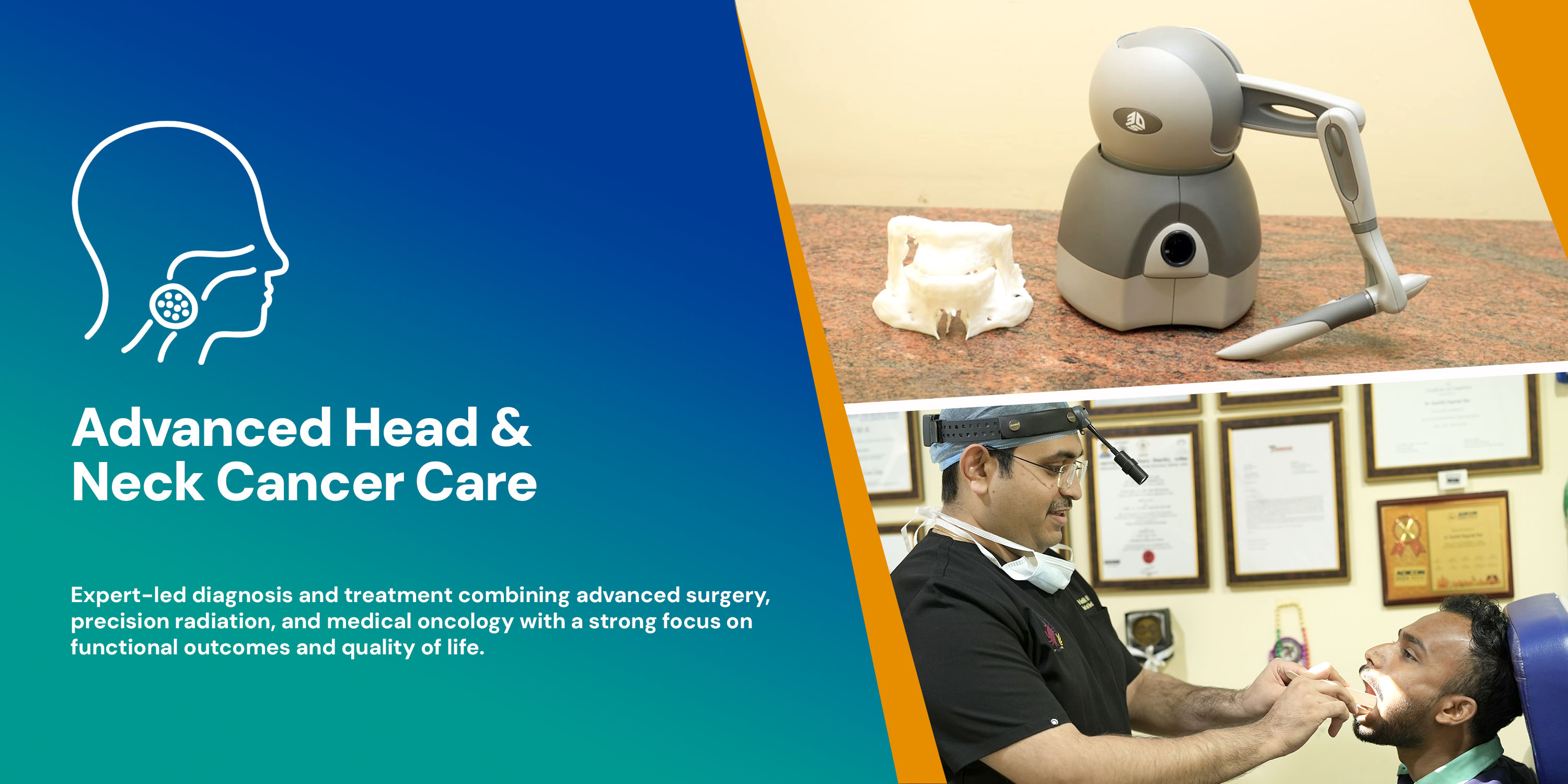
We provide compassionate, comprehensive care for all head and neck conditions, from routine to highly complex. Our core principle is 'Functional Head and Neck Surgery'—we never compromise on cancer control while passionately focusing on preserving your speech, swallowing, and quality of life.
This is supported by routine microvascular reconstruction and also specific expertise in complex skull-base surgery (both endoscopic and open). Our surgeons, including Dr. Karthik N Rao, the International Chair of the American Head & Neck Society's Skull Base Section, are dedicated to this balanced approach.
Our team is home to significant surgical experience and volume. Patients consistently place their trust in us, often after their consultations, drawn by our compassionate, evidence-based care and exceptional functional outcomes.
Most notably in rehabilitating total glossectomy patients to speak and eat again
Every patient's journey is supported by a fully integrated team, ensuring holistic, world-class care.
Our strong research focus directly informs and improves clinical practice. All consultants are Fellows of the American Head & Neck Society, and we are proud to have published ~50 research papers in the last two years, often co-authored with leading institutes across the globe.
Dr. Karthik N Rao serves as Editor for Nature Scientific Reports, one of the leading scientific journal in the world.
Dr. Sreeram M P contributes as Co-Chair of the Translational Research Committee for HNCIG
As a trust hospital, we provide world-class care at costs typically 40–50% lower than other hospitals. Subsidies are applied proactively, and our Charity Cell offers further support to all, irrespective of background.
NABH & NABL Accredited
24/7 Emergency Services
Our doctors are trained at prestigious high-volume institutes (Tata Memorial, AIIMS). Their excellence has been recognized with awards such as:
Dhanvantri Award (Gold Medal) from the President of India - Dr. Karthik N Rao
FHNO Gold Medal for Basic Research - Dr. Prajwal Dange
We are equipped with advanced technology, including an in-house 3D printing lab and AI-based treatment planning, ensuring precision care.
We treat every patient as a family, approaching your care with empathy and humility. We walk alongside you throughout your cancer journey, providing not just medical expertise but constant motivation and support. While being pragmatic about outcomes, we focus on hope and progress, ensuring you never face this challenge alone.
Comprehensive Rehabilitation
Peer Support & Survivorship Care
Screening Camps & Awareness
We are here to guide you through your journey with expertise, compassion, and an unwavering focus on your return to a full life.